
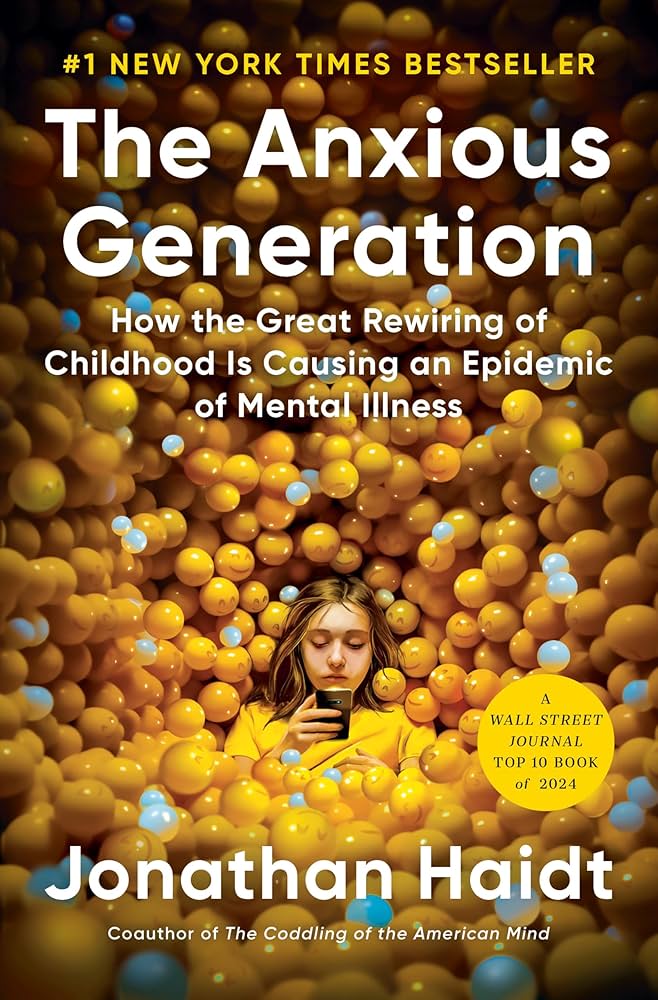
I’ve been thinking a lot lately about The Anxious Generation by Jonathan Haidt—honestly, it hit me pretty hard when I read it. It’s one of those books that makes you look around at the kids in your life or even reflect on your own habits if you’re anywhere near that generation and go, Damn, this explains so much. The core idea that stuck with me is this “Great Rewiring” thing Haidt talks about. Kids born roughly from the mid-90s onward grew up in a completely different world than we did.
90’s Childhood
Childhood used to be play based —outdoors, messing around with friends, getting scraped up, dealing with real rejection or conflict in small groups where you actually had to face people. That stuff builds resilience, social skills, the ability to handle life’s messiness. But starting around the late 2000s/early 2010s, with smartphones exploding and those addictive algorithms kicking in, it flipped to a phone-based childhood. Everything moved indoors, disembodied, asynchronous. You can be “connected” to hundreds of people, but it’s low-stakes—you join a group with one tap, leave with another. No real pain from rejection, but also no real belonging or growth from navigating it.
20’s Childhood
He nails the toxic combo like over-protection in the real world for example parents hovering, no free play, kids not allowed to roam or take risks and under-protection in the virtual world (unlimited access to social media, doom-scrolling, comparison traps, addiction designed right into the apps). It’s like we bubble-wrapped kids from every scraped knee or awkward playground moment, but threw them into a digital arena with no guardrails where algorithms tune their nervous systems for outrage, likes, and endless comparison. The stats he pulls are brutal—sharp spikes in anxiety, depression, self-harm, eating disorders right around when smartphones became ubiquitous. Girls seem hit harder by social media’s perfectionism and social comparison; boys more by withdrawing into gaming or porn worlds.
Harms Nobody Talks About
And the four big harms author lays out?
- Social deprivation less real connection.
- Sleep deprivation (blue light + late-night scrolling),
- Attention fragmentation (constant notifications wrecking focus), and
- Straight-up addiction (30-40 hours a week on devices for some teens).
It feels eerily spot-on with what I’ve seen in younger folks—entering adulthood feeling eroded, not traumatized in big dramatic ways, but slowly worn down by a childhood that skipped key developmental stuff. I keep coming back to his sense-check question: Think about your own childhood—what age were you allowed to go out and play unsupervised? Now look at kids today—what age are they still glued inside or only let out for structured activities?
My Childhood Was Better
For me, it was like 7 or 8; I’d disappear on my bike for hours. Today? Many parents won’t let their 12-year-olds walk to a friend’s house alone. We’ve traded real-world risks (which kids are anti-fragile to) for virtual ones that quietly rewire brains for fragility. Haidt doesn’t pretend to have perfect fixes, he’s realistic that this is a collective action problem.
Parents feel stuck because “everyone else’s kid has a phone.” But he pushes some clear norms that make sense to me:- No smartphones before high school flip phones if needed for emergencies.- No social media before 16.- Phone-free schools let kids actually talk during breaks- Way more free play and independence in the real world—let them climb trees, argue with friends, figure shit out without adults micromanaging. He admits these feel hopeful more than guaranteed, but collective pressure parents banding together, schools stepping up could shift things. Phone-free schools seem especially doable and powerful.
Messy World
Look, the book unsettled me because it’s not just “kids these days.” It’s us—adults—who let this happen, me included. I catch myself doom-scrolling, comparing, fragmenting my own attention. If it’s doing this to grown brains, imagine what it’s done to developing ones. But it’s also hopeful in a weird way: we rewired childhood once accidentally; maybe we can start rewiring it back toward something more human. If you’re a parent, teacher, or just someone who cares about the next generation, read this. It’s raw, data-backed, and it forces you to ask hard questions. What kind of childhood are we giving kids? And what are we losing if we don’t change course? What about you has anything like this rung true in your life or with people around you? I’d love to hear. (Please Comment)
Back to Author
Haidt’s proposed reforms in The Anxious Generation really boil down to four clear, practical “new norms” that he thinks could help roll back the phone-based childhood and bring back something healthier and more play-based. He presents them as foundational changes—stuff parents, schools, communities, and even governments can push for collectively, because going it alone feels impossible when “everyone else” is doing the opposite.
Solution Straight From The Book
- 1. No smartphones before high school roughly age 14, or 9th grade. The idea is to delay full, round-the-clock internet access. Parents should stick to basic “Simple” phones (calls/texts only, no browser or app ecosystem) if a kid needs something for emergencies or coordination before then. Haidt argues this protects kids during the most vulnerable brain-development years from constant connectivity that fragments attention and hooks them early into addictive loops.
- No social media before 16. This one’s about shielding early puberty the “firehose” years from algorithmic social comparison, influencers, outrage bait, and perfectionism traps. He sees social media as especially toxic for developing brains girls often hit harder by body-image and exclusion stuff, boys by withdrawal into virtual worlds. Delaying until 16 lets kids build real-world social skills first, before diving into platforms designed to keep you scrolling.
- Phone-free schools from bell to bell. This is one of the most actionable and popular ones right now. Kids store phones, smartwatches anything that can text or distract in lockers, pouches, or bags during the whole school day. No sneaking checks between classes, no TikTok in the bathroom. Haidt says it frees up attention, boosts real face to face interaction, reduces bullying/cyber stuff during school hours, and just makes school feel more human again. A lot of districts and even whole countries are moving this way already.
- Far more independence, free play, and responsibility in the real world, This counters the over-protection side of the equation. Haidt wants parents to dial back the hovering let kids roam, climb trees, argue with friends without adult intervention, run errands, take risks that build resilience. Programs like Let Grow (which author co-founded) push things like “independence projects” for example send your 9 year old to buy milk alone or let them walk to a park. The goal is to rebuild antifragility through real-world experience, replacing screen time with messy, embodied play that used to be normal.
What I like about these is they’re not pie in the sky. Haidt admits they’re tough because of collective-action traps parents hesitate if other kids have phones, schools worry about being outliers. But he frames them as norms worth coordinating around, parents banding together in friend groups or neighborhoods, schools leading with policies, even pushing governments for things like raising the COPPA age limit from 13 to 16 or age-verification laws.
Conclusion
He’s realistic too he knows these won’t fix everything overnight. And some like social media age limits might need legislation or tech-company cooperation. But the tone feels hopeful & we’ve accidentally rewired childhood once; we can start unwinding it with simple, shared rules. Personally, these hit home because they feel doable at a family level while pointing to bigger shifts. The phone free schools one especially imagine recess where kids actually play tag instead of scrolling. Or just giving tweens a flip phone and saying “talk to your friends in person.” It wouldn’t solve the anxiety epidemic alone, but it could make a dent in the erosion Haidt describes. What do you think—any of these seem realistic in your circles, or do they feel too uphill? Have you seen schools or parents trying versions of this?
Keep reading
Read More I will be Publishing the Jeans Research paper about iGen.
Follow me on Instagram