
Atomic habits for Every UPSC and JEE aspirants knows the grind. The endless syllabus, the daunting competition, and the constant battle with procrastination and inconsistency. You’ve tried making grand study plans, only to see them crumble. You’ve bought all the books, joined the best coaching, but still, sometimes, it feels like you’re running on a treadmill, getting nowhere. What if the key to cracking these exams isn’t just more effort, but smarter, more consistent effort?
I am not saying that you should not study enough or skip classes or you are studying wrong but what i am trying to say is along with your studies keep these habits check because these are the important stuff that will keep your mind active & help you to achieve more in your studies as well as in real life.
So, Let’s Enter James Clear’s ‘Atomic Habits’ – a book that promises small changes for remarkable results. But can its Western-centric advice truly work for the unique challenges of Indian competitive exams like UPSC and JEE? Let’s find out.
Want to read more aesthetically in short time Click Here
Why “Atomic Habits” is a Game-Changer for UPSC/JEE Aspirants
Atomic Habits makes UPSC/JEE aspirants prep less about “how many hours you brag about” and more about how many days you can show up and get just a little better. The 1% rule gives a practical, guilt-free way to study consistently without burning out on unrealistic 10–12 hour marathons.
Why 1% Beats 12-Hour Marathons
James Clear’s core idea: if you get just 1% better each day for a year, you become about 37 times better; 1% worse daily takes you close to zero. That is exactly why consistency beats cramming in UPSC/JEE preparation. for aspirants.
- Instead of forcing 12-hour days you can’t sustain, lock in 3–4 hours of deep, distraction-free study every single day.
- Regular 3–4 hour blocks with revision and practice will compound far more than random 10–12 hour bursts followed by two days of fatigue, guilt, and scrolling.
- If you think i can deep study for 6 or 8 Hours then go ahead, Its all up to you.
For most aspirants, the real failure is not “only 4 hours today”, it is “0 hours for 3 days” after failing a schedule.
Turning 1% Atomic Habits into Daily Study Actions for Aspirants
The 1% rule becomes powerful when you translate it into tiny, automatic study actions rather than vague motivation.
- For UPSC: Aim to improve one small thing daily—answer 2 extra quality mains questions, revise one more micro-topic in Polity, or improve one weak area spotted in a test.
- For JEE: Slightly push your personal best—5 more problems, 10 more minutes of timed practice, or one extra concept revisited in physics or maths.
Think like this: “Today my only job is to be 1% better than yesterday’s version of me as an aspirant”, not “Today I must cover the whole syllabus.”
Micro-Goals: Laxmikanth and JEE Problems
Atomic Habits is built on shrinking the habit until it’s almost impossible to say no. That is exactly how a UPSC/JEE aspirant escapes overwhelm and starts moving daily.
- UPSC examples:
- Instead of “finish Constitution in a month”, set a micro-goal: “Today, just two articles of Laxmikanth with short handwritten notes”.
- Instead of “write one full test”, commit to “one GS question and one essay intro daily” so answer writing never breaks.
- JEE examples:
- Instead of “50 problems daily”, commit to “5 high-quality problems with full solutions and error analysis”
- Instead of “finish Organic Chemistry”, aim for “one reaction mechanism + 10 minutes of spaced revision of yesterday’s topic”
Micro-goals feel too small to resist, which means you actually do them—and that’s what compounds into the 37x effect over months.
Consistency Without Burnout
The 1% philosophy also protects mental health by lowering pressure and making “showing up” the main win.
- A realistic plan of 3–4 focused hours daily with micro-goals and regular revision reduces anxiety and last-minute panic compared to cramming.
- Even on bad days, doing the tiniest version (2 articles, 5 problems, 1 question) keeps your habit alive, so you never truly “break” preparation.
In a race like UPSC/JEE, the aspirant who can stay in the game steadily for 12–18 months wins over the one who keeps restarting after every burnout.
Environment design makes study obvious and frictionless…
…while hiding distractions that derail focus.
Dedicated Study Zone
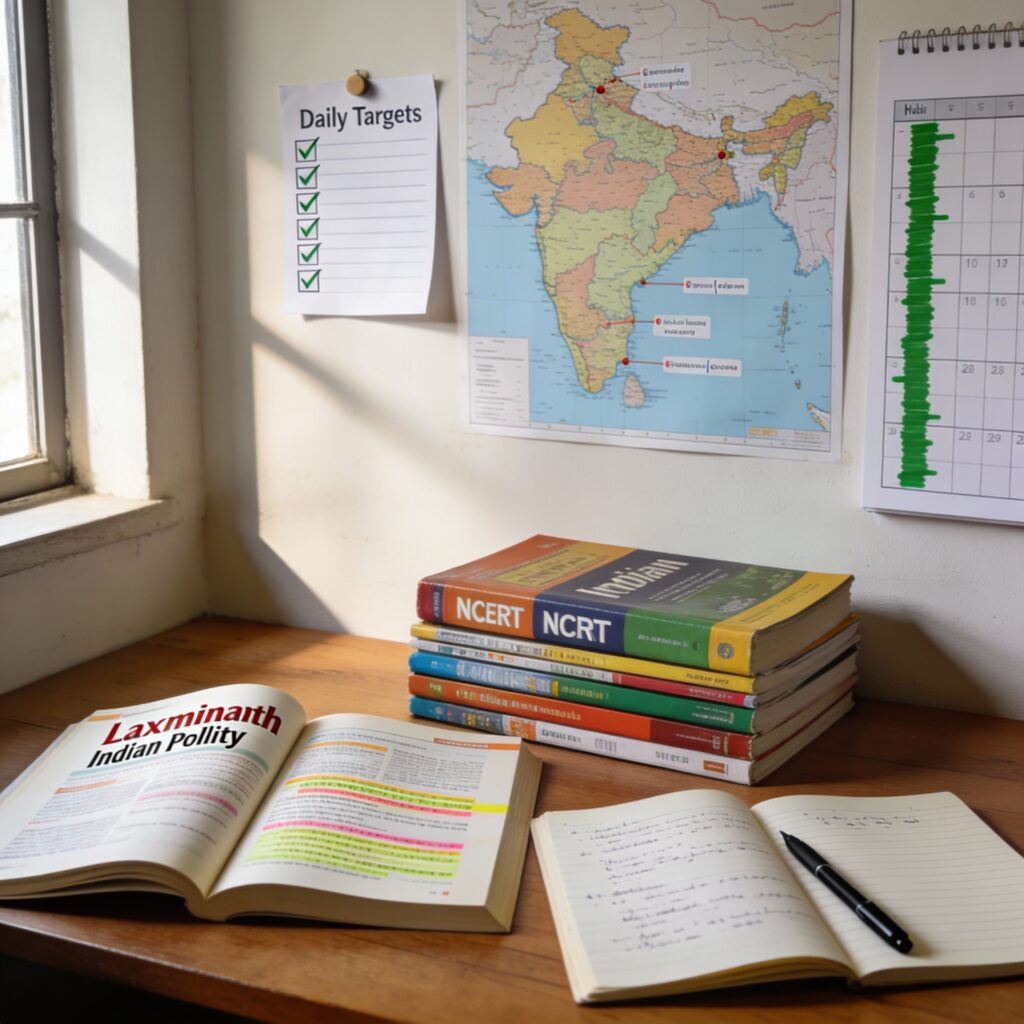
Clear emphasises creating spaces where study is the obvious choice by keeping essentials within arm’s reach and removing barriers. For UPSC/JEE aspirants, this means a fixed “no-phone zone” study corner that signals “serious work mode”.
- Designate one table or corner solely for study—keep Laxmikanth, NCERTs, pens, notebooks, and a water bottle right there so starting takes zero decisions.
- No eating, chatting, or sleeping in this zone; it trains your brain to associate that spot only with deep focus.
Toppers often use simple setups like this to study longer without mental resistance.
Remove Distractions
To make bad habits difficult, increase the steps between you and distractions. Phone notifications and multitasking are the biggest killers for UPSC/JEE prep, so physically separate them.
- Put your phone in another room, drawer, or use app blockers during 3–4 hour blocks—out of sight means out of mind.
- Ensure your study table isn’t your eating/entertainment spot; no laptop browsing or TV nearby to avoid “just 5 minutes” traps.
This setup lets you sustain focus for hours, as your environment naturally blocks the usual temptations.
Visual Cues for Daily Wins
Make good habits obvious by placing cues in plain sight, which prompts automatic action. For exams like UPSC/JEE, visual reminders keep your daily micro-goals and key info front-and-centre.
- Pin your daily target list (e.g., “2 Laxmikanth articles, 20 Polity MCQs”) on the desk or wall so it stares at you.
- Tape important formulas (JEE physics/chem), India map for geography (UPSC), or quick revision notes where your eyes naturally go.
These cues reduce decision fatigue and reinforce 1% improvements without extra effort—your desk becomes a silent coach.
Quick Environment Checklist
Apply these Atomic Habits tweaks today for a distraction-proof setup:
| Element | Do This | Why It Works |
|---|---|---|
| Desk | Only study books/notes in arm’s reach | Starting = 0 friction |
| Phone | Another room or blocked apps | Distractions take effort |
| Walls/Desk | Targets, maps, formulas pinned up | Cues trigger action automatically |
| Lighting | Table lamp + natural light if possible | Reduces eye strain, sharpens focus |
| Plants/Colors | Green tones, small plants | Calms mind, boosts retention |
This design turns your room into a habit machine where UPSC/JEE success feels inevitable or you can say achievable, not forced.
Four Laws for Exam Prep
James Clear’s laws simplify habit formation—apply them directly to make study obvious, attractive, easy, and satisfying.
Make It Obvious: Design cues that scream “study now”. Place NCERTs, problem sets, or today’s Polity notes on your desk or bed first thing in the morning so they’re impossible to ignore.
Make It Attractive: Pair tough tasks with rewards to build craving. Finish a difficult JEE mechanics chapter? Blast your favorite song or grab a 5-minute stretch—reward after, never before.
Make It Easy: Shrink tasks to reckless-simple starts. Stuck on advanced integrals? Solve 2 easy ones first. Overwhelmed by GS2? Read one sub-topic summary to gain momentum.
Make It Satisfying: Immediate feedback loops seal the habit. Tick off completed chapters on a wall chart, color-code your habit tracker, or log rising mock scores—visual proof keeps you hooked.
Basically Gamify your study life that is attractive to your mind that releases some positive chemical in your mind to repeat the tasks. for example language learning with Duolingo.
Common Pitfalls Fixed
Aspirants face exam-specific traps, but Atomic Habits provides targeted fixes.
Procrastination: Use the 2-minute rule—scale down to “do it now” size. Scan one current affairs headline (UPSC) or solve one basic math problem (JEE) instead of staring at the full pile.
Burnout: Treat rest as a sacred habit. Schedule 10-minute walks, 5-minute meditations, or power naps as non-negotiable “1% recovery” to sustain 12–18 month prep marathons.
Feeling Overwhelmed: Atomise the syllabus. Master one UPSC micro-topic (e.g., Fundamental Rights Article 14 only) or JEE sub-concept (one vector type) perfectly before expanding.
Lack of Motivation: Build streaks—track consecutive study days on a calendar. “Don’t break the chain!” It turns motivation into momentum, even on low days.
Action Plan
For UPSC and JEE aspirants, Atomic Habits isn’t just another self-help book; it’s a practical manual for success. It teaches you that consistent, tiny efforts are far more powerful than sporadic bursts of heroic effort. Stop waiting for motivation to strike, and start building systems that make success seem possible—pick one law today and tweak your desk or routine. Share your first 1% change in the comments!
As an Aspirants Which ‘Atomic Habit’ will you implement in your UPSC or JEE preparation starting today? Share your thoughts in the comments below!”
Read More About The Let Them Theory
Pingback: The Let them Theory by Mel Robbinson Book Review - The Right Book
Pingback: Human Nature by Robert Greene Book review - The Right Book